Coup d’état
For the first time in my life I’ve listened to sober discussions of coup d’état in the United States. A criminal regime weaponizing institutions of the state, pardoning convicted felons and attempting to blatantly overrule the verdict of a democratic process in the name of nationalism is the stuff of tyranny.
I have to admit that growing up in this country, I’ve been conditioned to think that despotic takeover of governments only happens in Eastern Europe, or in South America, or in Africa, or the Middle East. They happen in places without so called, western civility. Such things are not supposed to happen in these United States, home of Disneyland, Slavery, IBM and the Ku Klux Klan. But yet, here we are.
A traditional coup in today’s America remains unthinkable, but an ideological one is not farfetched. The radicalization of White supremacy seems to be the one thing that could drive this country mad and cause it to turn on itself. History is clear on that lesson.
I have long felt that America believes in itself too much. It is a great nation without question, but a perfect union is a yearning, not a state of being. America’s faith in America is spiritual. It’s its own orthodoxy. It runs marrow deep. It is so powerful that it conflates critique with heresy, retards redemptive confession and smothers the ability to apologize.
Needless to say, it refuses to confess its transgressions about race, the original and seemingly endless source of American sin. That stubborn refusal has brought us to this pass, where we’re contemplating coup in the United States.
Despite the obvious contradiction, Black people believe in America fiercely too. According to Langston Hughes, “I, too, sing America.” But we sing with a cautious harmony. America has turned against us before. Our faith in the nation really is the substance of things hoped for. It is not blind faith. It is faith with clarity and experience and calibrated expectations.
Black people know what it is like to be attacked by America and excluded from the American gospel. We’ve had our hearts broken historically and repeatedly. We have to rely on determination and imagination to envision the fullness of American greatness. Yet still we have faith, which is why this moment is so worrying. We know what America is capable of.
This moment feels like an inflection point similar to that between Reconstruction and Jim Crow at the turn of the 20th century. The American story isn’t long, it wasn’t that long ago.
Slavery began in the Americas in 1619, 157 years before the nation was born in 1776. It continued uninterrupted until the end of the Civil War in 1865. 246 years of slavery in a nation that is 244 years old. Not until 2022 will the United States have been a nation as long as slavery existed in what is now America.
The period of Reconstruction from 1865 to the late 1870’s was a whisper of enlightenment wedged between two dark ages. Jim Crow slammed the door on that era of American atonement and Black uplift from slavery. The Jim Crow era of racial apartheid lasted from the end of Reconstruction until the passage of the Voting Rights Act, the Civil Rights Act and ultimately the assassination of Martin Luther King in 1968. Just shy of one hundred years – until 4 years before I was born.
Modern America is only 52 years old.
The period from the assassination of Martin Luther King until the end of the Obama Administration in 2017, I argue was the second American Reconstruction. It was a period of approximately 50 years marked by the nation grappling with itself legislatively, socially and culturally. The nation was trying to emerge from the era of American apartheid. It was a period of constant tumultuous improvement and progress – hard won victories for modernity and civility over toxic White supremacy and intolerance. It was America at its best.
I have lived my entire life in the second American Reconstruction – in modern America. But all the while, there has been no reckoning. No exorcism of demons. The American sin remains smoldering and unrepentant, a ghost woven in the stitches of the flag waiting to be released.
Recently we’ve seen the streets of the capital city of the United States flooded with thousands of radicalized White people waving the flag of their messianic hero. Hints of Jim Crow and the trappings and slogans of 17th century American sins resurrected in them – men with swastikas etched into their skin wearing their ideology proudly, armed masked men draped in the American flag frothing with vitriol, Confederate flags waving prominently, sympathizers of American terrorists who planned to kidnap and murder a sitting United States governor. Timeless American slogans:
Fuck you niggers.
Go back where you came from.
White power.
Blue lives matter.
Jews will not replace us.
Love it or leave it.
U.S.A. U.S.A. U.S.A.
The slogans help us see the sides of this internal struggle more clearly. They force us to confront the contours of an America coup and the American idea with candor and sobriety.
During political seasons, like the one we’re in now, there are incessant references to “the American people.” The American people, in American political parlance, are the most just, triumphant and honorable people the world has ever known. Needless to say, Black people know better.
Contrary to the lure of post-disaster heroism or the portrait of Patton’s patriotism, America has darkness raging within it. Its better angels and its darkest instincts are constantly at war with each other. Both are equally real. Both are equally powerful, and both are equally American. Black people know them both, well.
Black people have a unique clarity of sight into the fullness of the American people because racism is intimate. It happens in close quarters. As a result, Black people can see the blind spot White people have of themselves. Not only can we hear the dog whistle of a tyrannical would-be despot, we have been attacked by real dogs unleashed by the state. We have a more complete view and experience of the American people, as American people.
For example. George Floyd, may he rest in peace, knows Officer Derek Chauvin and police in a way that White Americans can’t. He knows a version of police reserved for Black people – vile police, rude police, unforgiving police, guns drawn police, murderous police. He experiences the slogan, “Law and Order” in a way that Black people uniquely understand.
George Floyd knows what the police smells like, what its hands feel like, and the sound of its voice. He’s been close enough to feel the warmth of its breath and to feel the weight of its body against his own. He knows how racism can degrade the humanity of the police in absolute terms. He knows that the police can look you in the eye and slowly and unflinchingly choke you to death while you plead for mercy. George Floyd knows Officer Chauvin’s racist distain with a kind of sadistic intimacy.
White people don’t know that version. More broadly, they don’t experience that version of America. They don’t know the version of America that turns on you and attacks you because of your color. The version that depends on you and still calls you nigger. George Floyd and Officer Chauvin; however, are yet both, the American people. Black people and White people are both and at once, the American people.
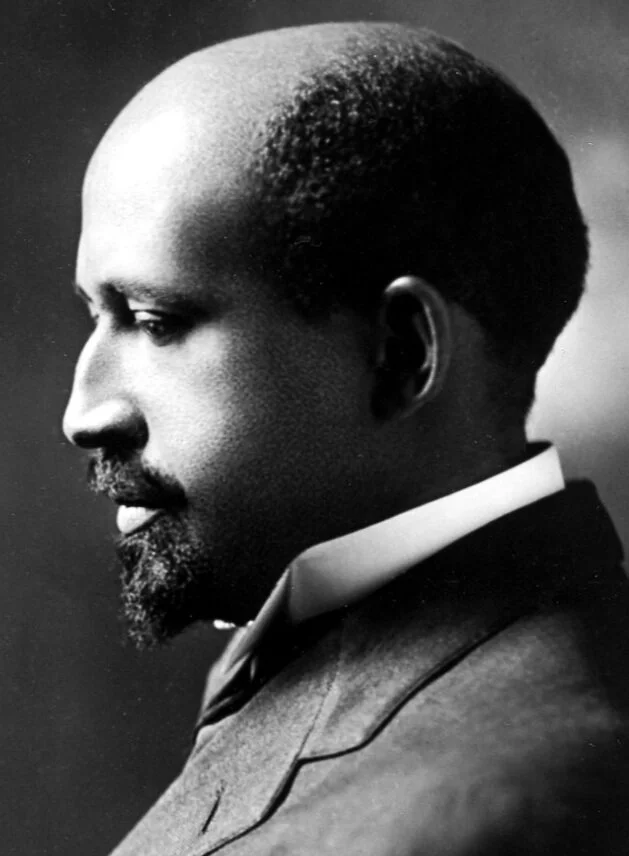
In 1897 W.E.B. DuBois wrote, Strivings of the Negro People. In it he explained how Black people cleave a path between being American and being Black. “One ever feels his twoness,” he wrote, “ - an American, a Negro; two souls, two thoughts, two unreconciled strivings; two warring ideals in one dark body, whose dogged strength alone keeps it from being torn asunder.”
This is also the story of the American people – a people of unreconciled strivings; of two warring ideals locked in one great and tortured nation. Our inability to reconcile our strivings, to agree on who an American is and for whom our American ideals apply remains our grand national challenge.
In the end, a coup will be averted by a more self-conscious American people. Ultimately, White supremacists and their more polished political acolytes will have to surrender and lay their ideology and their burden down. It is the only way. Our arguments are not parallel. There is no moral equivalence. We cannot live with endless internecine conflict and the perpetual subjugation of people. There will never be peace on those terms. Justice always comes first, then peace.
Recently when the election results were announced the country saw a flash of the other face of the American people. The organic celebrations are well documented by now. People erupted into the streets of Atlanta and in major urban centers all across the country – relieved and euphoric. It felt as if the chain around our national neck was loosened. We could breathe again.
Atlanta was choked with revelers. People were out by the thousands. In grid lock traffic horns and music were blaring, peace signs and power fists intertwined, American flags were waving everywhere alongside Black Lives Matter flags, Rainbow flags, and flags that simply said, “Thank God”. At one stop on John Lewis Freedom Parkway a woman in the car next to me was bawling – windows rolled up, all by herself, absorbing the moment, crying uncontrollably. People were exhaling. It felt as if the nation had course corrected, even if just for a moment. More than 80,000,000 Americans peered into the abyss of regressive racism, vulgarity and autocracy, and decided against those demons.
We chose something better.
What I saw confirmed my imagination of who the American people can be and what this nation ought to be. I was inspired to keep battling and my concerns of coup d’état quieted – for now.
kamau